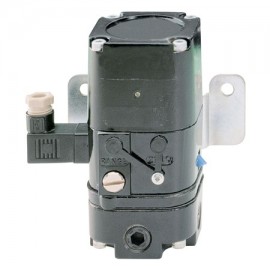
Designed for converting a 4 mA to 20 mA control signal into a proportional pneumatic output, this I/P converter spans 3 psi to 15 psi (0.2 bar to 1 bar). It holds ±1.5% accuracy, ports through 1/4" NPT, and wires through a DIN 43650 A connector. Great for pneumatic valve actuators and positioners.
Designed for converting a 4 mA to 20 mA control signal into a proportional pneumatic output, this I/P converter spans 3 psi to 15 psi (0.2 bar to 1 bar). It holds ±1.5% accuracy, ports through 1/4" NPT, and wires through a DIN 43650 A connector. Great for pneumatic valve actuators and positioners.
Zero adjustment of the unit is made by turning a screw that regulates the distance between the flapper valve and the air nozzle. Span adjustment is made by varying a potentiometer, which shunts input current past the coil. An integral volume flow booster provides adequate flow capacity, resulting in fast response time and accurate control.
The input current flows in the coil and produces a force between the coil and the flapper valve, which controls the servo pressure and the output pressure.
Both Series provide a reliable, repeatable, accurate means of converting an electrical signal into pneumatic pressure. Its force balance principle is a coil suspended in a magnetic field on a flexible mount. At the lower end of the coil is a flapper valve that operates against a precision ground nozzle to create a backpressure on the servo diaphragm of a booster relay.
A "current to pressure" converter (I/P) converts an analog signal (4 to 20 mA) to a proportional linear pneumatic output (3 to 15 psig). Its purpose is to translate the analog output from a control system into a precise, repeatable pressure value to control pneumatic actuators/operators, pneumatic valves, dampers, vanes, etc.
Both IP210 and IP210A are loop-powered instruments, which eliminates the need for an external power supply (except for IP210-X120).
OMEGA's IP210 and IP210A convert an analog signal (4 to 20 mA) to a proportional linear pneumatic output (3 to 15 psig). Its uncomplicated design and proven electromagnetic force balance deliver consistently high performance.
Features
Applications
| Pressure port | 1/4" FNPT |
| Electrical connection | DIN 43650 with screw terminals included |
| Media | Oil-free, clean, dry air filtered to 25 μm |
| Housing | NEMA 4 Type, Epoxy-painted zinc die castings |
| Input resistance | <300 Ω |
| Max supply pressure | 100 psi |
| Min supply pressure | 3 psi above maximum output pressure |
| Supply sensitivity | ±0.15% span per 1.5 psig |
| Operating temp | -20°F to 140°F (-29°C to 60°C) |
| Construction | Nitrile diaphragms, nozzle and supply valve, integral surface mounting bracket included |
| Failure mode | Upon electrical failure, the signal pressure falls to bleed pressure |
| Input range | 4 mA to 20 mA |
| Output range | 3 psig to 15 psig |
| Pressure port | 1/4" FNPT |
| Electrical connection | DIN 43650 with screw terminals included |
| Media | Oil-free, clean, dry air filtered to 25 μm |
| Housing | NEMA 4 Type, Epoxy-painted zinc die castings |
| Input resistance | <300 Ω |
| Max supply pressure | 100 psi |
| Min supply pressure | 3 psi above maximum output pressure |
| Supply sensitivity | ±0.15% span per 1.5 psig |
| Operating temp | -20°F to 140°F (-29°C to 60°C) |
| Construction | Nitrile diaphragms, nozzle and supply valve, integral surface mounting bracket included |
| Failure mode | Upon electrical failure, the signal pressure falls to bleed pressure |
| Input range | 4 mA to 20 mA |
| Output range | 3 psig to 15 psig |